The Romney statement concerning the “47%” is accurate in
terms that 47% of the Americans with income pay no federal income tax.Federal income tax is totally different from
Social Security and Medicare taxes which are subjected to wage income only.
I have been voting since 1974. In all these years, I have
yet to receive any mail from a democrat. In the state of Indiana in order to vote in a
primary, you must identify party affiliation and this is determined by which
party you “believe” will vote more for.This information is available from the Indiana Election commission and
is used by all parties to determine who to target campaign information.Since I have never voted in a democrat primary,
no democrat has ever sent me information on their campaign. Does this democrats
will not represent me, absolutely not?It just means with their limited resources, they are going to reach out
to voters they may be able to sway.Romney’s reference to the “47” is a blanket statement where it would be
difficult to change many within this groups’ minds.
I did not take it personally and in fact it changed my view of
Romney. I like a candidate who I can understand and a candidate who makes this
type of statement shows he is a logical thinker.What I cannot stand or illogical politicians
who promise many things and have no idea how to deliver.
Romney had not proposed detailed plans which I can
accept.A detailed plan by one person
will not represent the congress.What I
like is his conceptual ideas and his basic premise of what governments’
responsibility is.
Our tax code is a mess.We have different forms of income with different tax rates that
apply.However, many think all income is
created equal when in fact it is not.Wage income, for the majority, is pretty predictable. You work so many
hours and you get paid at a particular rate. Interest and dividends are some
one predictable, but subjected to change based on the economy.Capital gains are defined as short and long
term.A person invests money in some
entity with the objective of making a profit. Sometimes you win and sometimes
you lose. Capital gains are most likely the most un predictable income of
all.People invest in the unknown when
there is something to gain. If there is no incentive to invest, less investment
will be made, leaving people to take the save choice, banks or mattress.This option decreases velocity of money
through the market.
Right now our economy has lots of money sitting on the side
lines because no one knows what taxes will be, how congress will handle
deficits and world markets. We are in uncharted waters.We need a person who understands math, knows
that you cannot create something from nothing and that simply moving a chair
from one side of a ship to the other does not make things different.
I would like to see all deductions eliminated and the tax
rates lowered to achieve the same revenue.I do not support deductions for mortgage, charity, healthcare, personal
losses, etc that are found on schedule A.What a person spends there money on, is up to them and they should not
be subsidized by others. All we are doing is making the tax code more complex.
The child tax credit and tax credit for higher education are
also unnecessary.Those without children
are subsidizing those with children. Those making use of the higher education
tuition credit are being subsidized by those who are not seeking higher
education.In simple terms, those who
make use of these tax credits are receiving investment from others who do not
benefit from their investment.
One last parting comment. The last general federal budget
surplus was in 1957, 55 years ago. Every year since 1958 the US congress and
President have authorized spending more than federal general revenues. It is not right to borrow money for
appropriations, we the current voters want, but do not want to pay for, so we
borrow the money and pass the bill until our children and grandchildre
I watched the debate between Lugar and Murdock and found both to be flawed. I had been moving my support towards Murdock because of several votes by Lugar:
Lugar states he is for a balanced budget amendment, yet votes for increasing the debt limit. Would a failure of increasing the debt limit not be a balanced budget requirement?
Lugar stated he voted in 1983 to save Social Security. In 1983 Social Security faced the identical problem it faced in 1976, 1950 and precisely the problem identified by A.J. Altmeyer in 1943 and 1944 in his testimony before congress.The vote by Lugar to “save” social security was not to save social security, but was to kick the can down the road for some other future senator to deal with. The 1983 passage was done with the knowledge by all who voted that this would not restore full funding for Social Security for it was projected to exhaust the OASI trust fund by 2064.So the question I have for Lugar is simple: Who were you saving social security for; those who were close to retirement without representing those who were then baby boomers?Now you say changes should be made that do not affect those over age 55. Is this not the same identical stance you took in 1983?
Lugar voted for the bailouts of companies. It is my firm believer that companies that are not profitable need to go under.I have worked for two companies that filed for bankruptcy.Both companies were sold at auction.People were laid off, pensions reduced, employees who had 401K’s with company stock lost money.This is sad, but it happens.Loss was great among a few people, but society did not bail them out. In the case of banks, had banks gone under, the share holders would have lost their money; mutual funds, CEO, board of directors and others.A person who is diversified will suffer some loss, but not 100%.In the case of a bailout using taxpayer’s money, the taxpayer risked greatly for no reward.In fact it changes nothing about how companies do business. If they risk much the taxpayer is there to bail them out; legislated insurance without cost to the company.
When Murdock identified that funding the old Soviet Union’s dismantlement of nuclear weapons was “fundable” to other entities; Syria, etc. Lugar stated that was not true that there were restrictions.What Murdock said was 100% correct. If you have a budget that cannot pay for all categories you want funded, but some other entity is willing to fund one category, it frees up funding any of that one category to fund the other categories.
Murdock though during the debate clearly showed ignorance. Murdock stated funding the dismantling of nuclear weapons was funding other agendas.Yet at the same time he seemed unable to see the same applicability of this in other areas such as social security funding.He stated Social Security’s trust fund was raided or used for other government funding.Is this not identical to his term “Fundable?”Social Security’s excess tax contributions are deposited into a “trust fund.” This trust fund then invests in Special US Treasuries which are payable on demand. This allows the Social Security Trust fund immediate access to funds to pay benefits.This was done between 1971 and 1983 when the trust fund was exhausted. All the Treasury did was sell new treasuries before the demand date and exchange one old treasury with a new one. No increase in the national debt, just an ownership of that debt with a potentially higher/lower interest rate.The US treasury is responsible for borrowing up to the debt limit to cover authorized spending.When an individual, mutual fund or other entity buys a treasury note, are they interested in where the money is going to be spent? Do they have any control over where the money is going to be spent?No, there is no expectation of how the money is going to be spent.This external funding is the identical definition used by Murdock related to Fundable.
Murdock is extremely ignorant of how social security works. If he truly believes that scheduled benefits for those now age 55 and over can be maintained while changing the rules/promises of those age 54 and below, he is not qualified to be a senator who needs to understand not only how social security works, but plain simple mathematics.
Both Lugar and Murdock appear now to be very similar.This is a shame; I truly had been hoping the Murdock was a conservative.The Tea Party has made a terrible mistake in supporting this person.Clearly Murdock is not interested in serving the interest of those under age 55.His main interest like those of Lugar are those over age 55.This country has over 118 million potential voters under age 46, far more than those over age 46, yet the politicians have failed to realize this, but maybe not. If you do not represent those under age 46, they tend to get disinterested in government and not vote. This then maintains a smaller constituency you need to be responsible too.Maybe it has been the plan of politicians all along; be responsible to as few as possible.
I have feathers, does anyone have some tar?If the young want to change the direction of this country, you need to get out and vote. You outnumber all other combined voter groups. Make your voice heard, if not you will be just like the boomers in 1983, now paying the price for not letting their voice be heard.
Rush Limbaugh’s statement about birth control was wrong and directed incorrectly. Birth control is not a right. In fact it is not a medical necessity. The premise that Federal and State Governments can dictate what insurance offers and what must be covered is just plain wrong to begin with. Why is it governments’ role to restrict or expand health insurance?
When it comes to auto insurance I have the ability to choose liability, collision, compressive and each with different limits of coverage. States set minimum coverage for liability to make sure some amount of liability will be available to compensate others for your errors or accidents you cause. In fact many states will allow you to submit a bond to cover the place of insurance; if you have no accidents you end up keeping your bond and paying no insurance – self insured. However, state and federal governments now seem bent on specifying specific coverage and and now must provide “X” for free when it comes to health insurance.
In fact we can extend the debate to life insurance. I know of no Federal or State law/regulations that require anyone buy life insurance or that require insurance companies to cover specific losses. So I ask once again, why is government interfering with private business in a matter that is an individual choice? Clearly if insurance companies thought it was a good marketing tool to offer birth control, they would offer this on their own. In fact private insurance coverage can be obtained that does not cover the birth of a child if one so chooses. Again this is a choice, not a requirement.
The debate between Rush and the woman is that the woman thinks someone else should pay for her birth control – she wants them for free, in fact every insurance company she approaches should offer it for free. This makes life easier for her in that she does not need to sort through the myriads in differences between insurance companies and prices; simply put it reduces choice and so now all she has to do is compare price.
Are people that foolish that they believe things mandated by government are free? Pretty soon we will not be able to pick and choose what we want to buy, but it will be mandated for us.
The statement “Social Security is designed to be fair” is totally false. If it actually had a design behind it, there would be no unfunded liability. Had it been fair, the yearly statements I received from SSA would not be telling me of impending inability to pay 100% of scheduled benefits. If there was a design behind SS-OASI, then the money paid as to a collective cohort would be in direct proportion to the value of contributions paid plus the credited interest earned on these contributions which in turn would have been used to pay the collectives benefits.
In addition “But Social Security isn't nearly as sophisticated in its pricing as the annuities offered by private companies. The latter adjust payments according to changes in interest rates to keep the benefits of waiting fairly stable, but Social Security ignores interest rates.” This contradicts the implied statement “Social Security is designed” by stating it is not sophisticated in its pricing.
Social Security did not have a design, there was no thought as to how the program would actually pay benefits nor was there any mechanism in place that would regulate benefits except Congress retained the authority to change alter or abolish any portion of the Social Security Act without liability.
"In general, gains from delaying Social Security payments are greater during periods of low interest rates, all else held equal. They're also greater "for married couples relative to singles, for single women relative to single men, and (at most interest rates) for two-earner couples relative to one-earner couples," according to the study."
This is truly amazing news. When interest rates are low, SS-OASI's trust fund earns less, thus reducing the ability to pay scheduled benefits. So with lower interest rates does it reason that the scheduled benefit payment may drop from 76% to 60% or even less? Who is this guy writing for; Social Security or Dumb Money? By law, general revenues cannot be used to fund Social Security. This reasons when there is not enough funds to pay benefits, benefits are cut. The writer is basing his analysis on the premis that full scheduled benefits will be paid and that you were born prior to 1948.
If we were really talking about smart money, we would be talking about repealing the Social Security Act pertaining to Old Age Survivors Insurance. The reason simple, a person born after 1985 can expect at most to receive 29 cents in benefits for each dollar paid in contributions and US Treasury Paid Interest.
Robert Ball Commissioner of Social Security 1962 and 1973,Wrote June 2005
“When Social Security began, benefits for those nearing retirement age were much higher than could have been paid for by the contributions of those workers and their employers. This was done so that the program could begin paying meaningful benefits even though workers nearing retirement would have only a short time to contribute.” “Instead, the impression is left that the program was sound only when 16 paid in for every one taking out. Thus, of course, when the ratio changed to 3.3 to 1, the program became “unsustainable.”
“They ignore the fact that in 1950 only about 15 percent of the elderly were eligible for benefits and that it was expected by all who were acquainted with the program that the ratio would, of course, change dramatically as a greater proportion of the elderly became beneficiaries.”
“What in fact happened is that when just about all the elderly first became eligible for Social Security benefits, about 1975, the ratio was 3.3 contributors to each beneficiary and the ratio has stayed that way for the past 30 years. As the baby boom reaches retirement age, as the administration says, the ratio is expected to drop for the long run to 2.0 or 1.9 workers to each retiree”
Warren Buffet, media and pundants seem unable to perform simple math. The single person pays the highest tax of al filers. The tax rates are pretty straight forward for a single person;
2011 Tax rates 15% on over $0 to under $8,375 25% on over $8,375 to under $34,000 28% on over $34,000 to under $82,400 33% on over $82,000 to under $171,850 35% on all amounts over $373,650
For the secretary to pay 35% tax, would require she make far greater than $373,650. She must be no ordinary secretary. Even if she had some portion of income taxed at 35%, she would have had to make $373,650, but her total tax on this $373,650 would be only 29% overall. To even get to 34% would require an income, after deductions and exemptions, of $2,235,625.00
Formula is simple:
34% = ($108,421.25 + 35% x (taxable income - $373,650)) divided by (taxable income)
Does he pay his secretary this much?
Then there is the issue of risk. Investing capital to make money is a bit different than going to work and performing a task. An investor has the potential to lose a substantial amount of their capital. The worker works an hour, gets paid for that hour. The risk to the worker is that they get laid off, but the worker has no capital at risk. This is the simplistic reasoning of capital gains tax and taxes on earned income. There is also a different tax rate for dividends that come from capital that is at risk. Earned income is taxed at a higher rate because it is least at risk.
Decades ago, capital gains were taxed in the following way: 40% of gains were taxed at the ordinary tax rate. This means that if the ordinary tax was 28%, your capital gains tax was 14%. If you were in the lowest tax bracket of 15%, your capital gains tax rate was 7.5%. The change from this method to the current benefited the highest income brackets at the expense of the low income brackets. I think the old method was fairer and easier to calculate.
The majority of Americans support a balanced budget amendment. They expect congress to live within its means. At the same time Senator Lugar and Representative Stutzman, two out of many elected representatives both support the fair tax measure, specifically the national sales tax of 23%. This tax would combine the Social Security Old Age Survivors Insurance tax of 10.6%, Social Security Disability tax of 1.8%, Medicare Tax of 2.9% on wages with the death tax, and Federal Income tax which has tax brackets of 10%, 15%, 28%, 33% or 35%. In essence it would do away with the Internal Revenue Service.
It does not surprise me that the Fair Tax of 23% would conflict with the majority of Americans who support a balanced budget. Two of the largest programs already have balance budget statutes. Both Social Security and Medicare cannot borrow money nor can Federal General Revenues be used to support these two programs. These programs can only consume their respected dedicated payroll taxes and the funds in their respected trust funds. United States Code Title 42, Chapter7, Subchapter VII, Sec. 911 (a). This statute was passed in 1984 after the Big Fix of 1983 which raised the social security based, tax, retirement age and began subjecting social security benefits to federal taxation. This statutes primary goal was to restrain both Social Security and Medicare from consuming all federal revenues.
The fair tax would remove the balanced budget statute from these two programs. We have seen how congress is inadequate to cut just $120 Billion a year from $1.5 Trillion deficits. Combining these dedicated payroll taxes with Federal General Revenues will cause even more budget constipation. We should be focusing on the General Budget separately, not combined with two programs with very difficult ideologies. When attempting to solve a problem, you separate the problem into its basic parts, not combine many different problems. This only leads to pointing fingers.
However, the national sales tax has other problems. Workers who have saved money to make a purchase of a home, car, etc in the future have paid payroll taxes and these funds have been subjected to federal income taxes already. The national sales tax would now tax them once again. For 50% of workers, they have already paid 7.65% payroll tax and had no federal income tax liability. This would be like paying 31% tax on each dollar earned. For those other 50% of the people this savings was most likely taxed at a minimum of 10%. This other 50% of the work force would be then have 41% of each dollar they saved subjected to 41% federal tax.
However, there are those who would fair just slightly better. Those who set aside pretax money in 401K’s or IRA’s would not have paid tax on this income and with the Federal Income Tax eliminated would escape subject to the current tax when withdrawn. Granted, 23% would be far greater than the current federal income tax structure, but less than after tax savings.
Municipal bonds are generally free from all state and federal income taxes. One reason for government to do this is to lower their cost of borrowing. With a national sales tax, there is no incentive to invest in municipal bonds that pay a lower rate if in the end a taxpayer ends up paying 23% tax on it.
We then have to ask the question, what about Veterans Disability payments for service connected injuries? Those who are injured in the line of service and receive disability payments currently pay no federal or social security taxes on these payments. With the fair tax, these funds would now be taxed when spent at 23%. We also have insurance payments that are currently untaxed as well as pain and suffering payments from law suits where negligence of another party caused injury now being taxes at 23%. It is very possible while trying to simplify the tax structure of the US; we create a nightmare of other problems, Unintended Consequences.
Yard/garage sales would see a boom as a way to escape 23% sales tax. I would predict automobiles would see the average age on the road increase by 20%. Currently the there are 14 million cars sold in the US. These owners keep cars about 4 years and then are sold as used. I could envision that these new car buyers would now keep their cars 5 or even six years, reducing sales to fewer than 11 million cars, possibly even more. Used cars would see a boom as well as auto maintenance suppliers and services.
Americans are resourceful and this sales tax would lead to more conservation of resources by utilizing produced goods for a longer period of time. This would reduce manufacturing jobs and innovation as the market adjusts to less demand.
Then there is the question about Social Security. Social Security is paid to those who have wages subjected to the Social Security base. If you have no wages, you are not eligible for social security unless you qualify as a spouse or dependent. The elimination of the payroll tax and the enacting of a sales tax would have all people supporting social security, even those who paid and are now beneficiaries. Would everyone now be covered since they now support the program through sales taxes? How would benefits be calculated. Currently there is no link between taxes paid and benefits received. Combining these revenue sources into one may result in either faster means testing of Social Security and reducing it to a welfare program, outright repeal of the program and combining it with the current welfare programs or the near total consumption of all revenue and cuts to all other programs.
As an engineer, I would prefer keeping the programs and dedicated taxes separated. Review the programs effectiveness based on its needs alone. If the program is not self supporting by its revenue source, then the decision to raise taxes or cuts benefits does to become more of a political nightmare that we have now.
Myth 6 High deficits in the future make it difficult to pay social security benefits Social Security by law cannot borrow money. It has statutory authority to spend only those funds received from the dedicated social security tax on wages, tax on benefits and funds in the trust fund. Federal Law prohibits transferring general revenues to any trust fund. [4]
By law the trust fund cannot be drawn down to zero. The trustees must submit a report promptly to congress detailing benefit cuts or tax increases when in any given year the trust fund is projected to fall below 20% of that given years expenses. Social Security's ability to pay future promised benefits is dependent solely on the ability to raise social security taxes. [5]
4] United States Code Title 42, Chapter7, Subchapter VII, Sec. 911 (a), http://www4.law.cornell.edu/uscode/42/911.html
[5] United States Code Title 42, Chapter7, Subchapter VII, Sec. 910 (a), http://www4.law.cornell.edu/uscode/42/910.html
It is amazing how some government agencies just seem to not think ahead, even when it is their responsibility to think ahead. The 4th of July is a time of celebration, but that does not mean Mother Nature or life itself comes to a standstill. Having lived here since 1963, I know how many people go to the fireworks. They used to be held at McMillen Park where I as many other scouts would sell hot dogs, drink, candy and other “fine” snacks. The next day the area was a mess and we would be there bright and early to begin picking up all the trash.
They are no longer held at McMillen Park, but at Johnny Appleseed Park. This area is probably better suited with far more parking, but less sitting area than McMillen Park. With more people comes a bit more planning that is necessary. With thousands of cars exiting and the new stop light on Coliseum due to the removal of the tunnel which allowed those turning left onto Coliseum, there is a basic 15 car limit that can turn on a single light change. The Fantastic Fort Wayne Police Department however makes this look like a cake walk when they begin to close down south bound lanes north of Coliseum.
Did anyone think about the location of either Parkview Hospital or the Veterans Hospital off both State and Lake Streets and how closing south bound traffic on St. Joe Road and Clinton might hamper those needing emergency care? After speaking with Marty Bender on the phone for a short period of time, I got the distinct impression from his response and words used “evacuation of the area” was their main concern. I interpreted this to mean the FWPD's main concern was the evacuation of the Coliseum Parking lot. What I do not understand is how limiting south bound traffic and routing them further east or further west, actually they did not reroute, they simply waved their lights to keep moving, keeping you from making a turn south, would actually cleared the coliseum parking lot any quicker, safer or efficiently.
For those unlucky enough to have a medical emergency, trying to get to either Parkview or the VA Hospitals was very difficult. Even when you waved to a FWPD officer, they simply could care less. They walked like it was out of their way to come close enough to hear your need. “We are here to serve and protect” takes on a whole new meaning in a situation like this. First the officer asked the others where the medic had gone. Getting no response from the other non caring FWPD officers, the officer made a call to dispatch or someone on the radio to find out if an EMS unit could be sent or where the medic was. A transport by TRAA can exceed $1,400. A minute had gone by and still the officer was trying to divert a driver carrying a person in need of medical attention further away from the hospital it self when there was not a single car traveling south on St. Joe Road. The officer said the driver should wait for an EMS. How would an EMS get through all this traffic they created? The hospital was less than five minutes south. Finally, the officer motioned another officer to move their car out of the way to allow the driver to make a right turn. The entire distance between Washington Center and State Street had not a single car going south, but the north bound lane was bumper to bumper both lanes. In addition Washington Center Road east was bumper to bumper because the street narrows to one lane at the next stop light. So instead of utilizing several south bound streets, FWPD diverted these drivers east and west to basically two lane roads with half the capacity and shorter traffic light intervals resulting in compounding the traffic problem.
You would think that this would be the end, but two more sets of “FWPD” police car road blocks were blocking the road. What is simply amazing is that the Crescent Street and St. Joe road intersection had no police there directing any traffic. So who made the big decision to block south bound traffic? Clearly any theoretical traffic traveling south on St. Joe Road was not going to create a problem simply because Traffic Lights were being used to control flow, not FWPD.
My question is simple; Do police officers know how to direct traffic of this magnitude and if so, where do they learn the basics? Maybe traffic engineers should be consulted on tasks of this size?
Over the past week, an individual contacted me about Social Security and what I thought of the Heritage Plan. The plan is 50 pages in length. After reading it I am very disappointed that those names on the plan, who endorse the plan did so.
The plan has no validity period. It does not use an independent model or provide any assumptions. It refers to CBO reports and from this speculate what changing table values by assuming different growths such as inflation, wage, GDP, productivity, etc will some how filter back into the original algorithum used to analyze a set of assumptions and create a new projection that is accurate. This is far from the truth. Projecting the cash flow of social security is a non linear process.
Population distribution or demographics are not linear. Each cohort has their own unique total numbers. A boom begets a boom and a bust begets a bust. As people turn 18, they generally begin to work and somewhere at age 65 they begin to retire or are retired. This is certainly not a linear progression, more like a big python eating a dog that can be seen from the outside as a lump moving down. Wages increase and then stagnate as you reach a particular age. The number of workers in each cohort for each year change slightly resulting in different non linear OASI revenues. Each working cohort will have their own replacement factor set when they turn age 60. This is used to determine that cohorts initial OASI benefit. Clearly this is non linear and assuming wage growth increases at a faster growth will increase revenues,but at the same time it increases the initial OASI benefit for each cohort at the same exact rate. By not using the same algorithum (assuming the CBO model is correct) there is considerable error.
The Heritage Foundation asserts that doing nothing to fix Social Security and Medicare will lead to economic collapse. They support this by stating that the trust fund for OASI will be exhausted in 2037 and there after will require more than $350 Billion of borrowing or funds from the general revenue fund. This is not true. Based on current legislation passed in 1984, neither social security or Medicare may borrow funds and general revenues may not be used to fund these programs. The simple fact of the legislation of 1984 clearly identifies that when a trust fund (either program) reaches 20% of any given years expenses, across the board takes place. Clearly there is no borrowing. The Heritage foundation cites a cut in OASI benefits of 22%, but fails to identify this as a benefit without COLA.
The Heritage Foundation then uses GDP as the benchmark for Social Security revenues and expenses. Table 6 in their plan clearly shows current benefits as a percent of GDP is far greater now than in the future. In fact the Heritage plan states they want a flat benefit for everyone, eliminating the link between wages and the initial OASI benefit. They state this benefit at $12,000 a year adjusted by wage growth. In addition their plan is to divert 6% of payroll taxes to a workers account such as an IRA. They make no changes to current or soon to be beneficiaries. but only to those in the future. Retirement age will be increased by a month every two years. This is about the rate of growth in life expectancy at age 67, but it far exceeds the actuarial basis of the cash flow. A person who delays retirement by one year, can be retired for 2.5 years more or it takes 2.5 years worth of additional benefits to recoup the delay in retirement and extra taxes paid.
However, the single largest sin I see in their report is the claim that they improve benefits. From table 6 they clearly show the benefit costs being reduced by 55%,far more than the 22% under current legislation. So is the Heritage Foundation attempting to con the American People with a plan to get something from nothing?
They say a flat tax of 18.5% of GDP will limit spending. The last time I checked, I do not pay income taxes, payroll taxes or excise taxes as a percent of GDP. I pay income and payroll taxes based on wages earned. GDP is nearly twice that of all income reported to the IRS for tax purposes. Clearly this would indicate that the true tax they wish to impose is 39%. They would eliminate the legislation of 1984 that separates the budgets and revenues for Social Security, Medicare and General budget. No longer would there be a mandated cap on Social Security or Medicare expenses. In fact much of the unfunded liability would be transferred to the General Budget that is already running $1.7 Trillion deficits and has a national debt of $14.3 Trillion.
The Heritage Foundation thinks they are saving or fixing Social Security and Medicare for future generations. Maybe they should ask these future generations if they want these programs. The Heritage Foundation proposes that $55,000 a year income for seniors is the point at which OASI Benefits would be taxed and when their non OASI income reaches $110,000 a year, their OASI benefits are 100% taxed away. This makes OASI a welfare program,clearly not want FDR envisioned.
The Heritage Foundation does not provide any information on how the transition between diverting 6% of payroll tax to individual accounts gets paid. A 21 year old today will work ~45 years before reaching retirement age. Clearly diverting and investing 6% will be more than enough to replace the OASI benefit, yet these workers may not save a dime in excess of the 6% and receive the equivalent $12,000 flat OASI benefit in the future. I see no basis on how this transition period is paid for over 45 years or how in 45 years the OASI benefit which higher than today's benefit can be paid.
As an engineer I have seen proposals that insinuate perpetual motion is viable, but in the end they have all failed. Social Security is no where near being viable. I have lost all respect now for the Heritage Foundation. I simply cannot trust what they present any longer. I suggest you ask them the hard questions as well.
My plan can be found at http://www.justsayno.50megs.com/ss.html
Just 18 cents per American per day employes 200,000
Last night on channel ABC World News Tonight, Diane Sawyer, had a piece on buying American. The cost to employ 200,000 workers is just 18 cents per day per American. The hype is that this is just a small price to pay. The question I have is, who says it is such a small price to pay?
There are 330 million Americans in the US per the last census. There are 365 days in a year. Pretty simple math to take 330 x 365 x 0.18 right? The answer is $21,681,000,000 or $21.681 Billion. If we divide this by the 200,000 that would be employed, we find the cost to employ one person is $108,405. This is a lot more than I make in a year.
There are seven in my family and the cost to my family would be $459.90. Now I am a pretty frugal person. $459 would pay the public school tuition for my minor children. It would also be enough to pay the cost of the used college text books for a year. It would also allow my family the luxury of buying pizza about twice a month. It would also allow me to save $459 more in a given year to help secure my retirement.
The problem is employing 200,000 out of the more than 14 million unemployed really does very little. If the goal is to employ all, then we need to spend $1.52 trillion more in a year or for my family of seven would be $32,193 a year. Sorry, this is not possible for me or for that matter very many American Families.
What is the answer to our unemployment problem? First we have inefficient tax laws. It rewards spenders and punishes savings. The fair tax law is not the answer, but an elimination of all exemptions and credits is. What you do with your money is up to you. The market place is the responsible entity for rewarding creativity, invention and efficiency. If solar power is better than burning coal then coal will go the age of dinosaurs. If wind power is cheaper than nuclear, then nuclear plants will not be built. If electric cars are truly the future than gas powered cars will slowly go away.
What we need is the best products making it to the market based on their merits, not some government mandate, tax credit or incentive. We should not be subsidizing workers by simply buying American. This means our products are more expensive and not competitive abroad. We need to be competitive with all other countries. The day of high standard of living is gone due to government spending and continual annual deficits since 1958. We need to spend less, save more and be the capital market of the world.
In Friday’s paper I found a paid advertisement inside the “Boomertime in Northeast Indiana vol3, issue 2, 2010.” The paid advertisement was titled “Social Security What you need to know today for tomorrow and the future.” It states Social Security the most successful domestic government program in our nation’s history. I am not sure of their definition of successful, but mine is one that works, not one that has unfunded liabilities exceeding $23 Trillion, unable to pay full benefits to those after 2037 and then can pay but 73% of promised benefits under current law (no COLA) and requires changing the “rules” after the fact and more. To put it bluntly the article calls Social Security an “Intergenerational Contract.” I never signed a contract to participate in a ponzi scheme. I certainly have not signed my children up to participate in the Social Security ponzi scheme and I will not. It is not right to ask others to pay for a program that we ourselves were not willing to fund ourselves.
The article presented all the things Social Security does, but nothing about the inability, problems it faces in the future without raising the retirement age, taxes, base or cutting future benefits or how these problem will affect you. The only ones Social Security OASI has benefited are those who have retired. They have benefited at the expense of the American Worker who now suffer higher taxes than required to fund their own retirement, lower take home pay, less disposable income leading to longer term mortgages, lower saving rates and dependence on government.
On November 27, 1944, A. J. Altmeyer, Chairman reported to congress; “There is no question that the benefits promised under the present Federal old-age and survivors insurance system will cost far more than the 2 percent of payrolls now being collected. As I pointed out in my testimony of last year, none of the actuarial estimates which have been made on the basis of present economic conditions and other factors now clearly discernible result in a level annual cost of this insurance system of less than 4 percent of payroll.”…“Indeed, under certain assumptions the level annual cost has been estimated to be as much as 7 percent of payrolls. On the basis of a 4-percent-level annual cost it may be said that the reserve fund of this system already has a deficit of $6,600 million. On the basis of 7-percent-level annual cost it may be said that the reserve fund already has a deficit of about $16,500 million.” The payroll tax did not reach 8% until 1968 and by this time Social Security benefits had been expanded even more.
There has been decades of talk The only action taken is raising the payroll tax, base, retirement age, enrolling non covered workers and taxing benefits. The can has been kicked down the road long enough. When do we wake up and face the fact Social Security is the worse failure in American History?
To make things worse the American worker paid Boomertime of Northeast Indiana to print this garbage.
This Gulf Oil spill is really making me upset on several fronts. First the technical aspects are criminal. A company decides to drill for oil in 5,000 feet of ocean. On land, the question asked is what is done to contain spills or blow outs, fires, etc. At sea, what were the potential problems? As an engineer, I know that submarines do not go below 2,000 feet or if they do not much more, definitely not 5,000 feet. There are small submersibles that go that deep.
Question one is how do they put equipment on the sea floor? Do they weld under water? Do they use fasteners under water? Do they just use mechanical fit ups to make seals? How on earth do they lay miles of pipe down 5,000 feet?
Looking at the blowout preventer and the associated pipe, it seems to be on top of the sea bed. Clearly they did not lower this as a single unit.
Three companies are involved BP, Transocean and Halliburton. Deepwater Horizon is a floating drilling platform owned by Transocean. Halliburton was the brains behind the drilling and provided the necessary expertise. British Petroleum leased a floating oil rig. BP hired Halliburton to drill the well. BP held the lease for the section of ocean floor.
One employee alleges that rubber was found in core samples after a test of the emergency blowout preventer. During the test an operator error caused a section of pipe to be extracted through the rubber sealed blowout preventer. The rubber found in the core sample was disregarded by others.
Not knowing much about drilling, but have experience with pumps, I wonder why we have such a problem.
THE PROBLEM: Broken 21 inch diameter pipe located 5,000 feet below the ocean surface on the sea floor. It appears to be jagged and not vertical. The oil seems to be exiting the pipe and makes a directional change upwards. The oil is under pressure which causes the oil to seek an outlet (broken pipe).
ATTEMPTED SOLUTIONS: BP has tried pumping mud into the blow out preventer. From all the diagrams I have seen, the inside piping is smooth and straight. I find that pumping mud into this unit with an unblocked exit un promising at best. The mud may prevent the oil from escaping, but as soon as the mud is consumed, the oil will no longer be blocked by the mud.
BP then tried a junk shot with the intention of blocking, stopping up the exit. Again they used gulf balls and other objects. What I find interesting is all the objects seemed to be round which means they would not tend to lodge against each other and form a mechanical blockage. Furthermore, since the outlet is open and the oil has created a good lubricant on the inside of the pipe walls, I would think the chances of a frictional interference slim.
MY TOUGHTS: My first thought was to lower 5,000 feet of large diameter culvert down over the exit. It would be difficult to pump oil up a hose, pipe or tube and keep it located close to the exiting oil let alone collecting the majority of the oil. The concept was to contain the oil and channel it under low pressure in respects to the sea water pressure up to the surface where it could be pumped into ships. Clearly the oil is leaking. Clearly the oil is rising. Clearly the oil goes with the current. Therefore, why fight the buoyancy aspect of the oil? Clearly the methane in the oil when it contacts sea water is causing a chemical reaction and freezes creating ice. How much ice? How large a chunks are we talking about? A diameter large enough could channel the oil to the surface, at least containing it to a smaller area.
My second thought was try and plug the outlet. The pipe is open and oil is gushing out. The diameter is 21 inches or 346 sq inches. If you were to attempt to block the exit, how close could you get to the outlet before the pressure would keep you from getting any closer? Maybe you could get within six inches of the outlet with a flat plate? This would not stop the flow, but it may allow the junk shot to work by creating a choke point of six inches not the 21 inch diameter outlet. A better idea would be to not block the outlet with a solid, but to put a titanium net, mesh, screen, lattice work or, grate at the outlet and then use the junk shot. The junk shot would have to be pieces larger than the mesh, grate or what ever at the outlet in order to capture/trap it. This would then begin to block the outlet. Clearly as the oil is blocked the pressure inside the pipe would rise. Design parameters of the pipe would have used total blockage using the blowout preventer and there should be no risk of a pipe rupture.
My third thought was to use under water robotics to saw a clean edge on the outlet of the pipe. Clamp/weld/bolt a coupling to the outside of the pipe with a new blow out preventer open. This would be needed so that the oil would not dislodge the blow out preventer from being secured to the broken pipe. Once secured, close the new blow out preventer.
If no one who is in the business of drilling for oil 5,000 feet down has thought about these and come up with reasons why these would not work, then these people need to find a new line of work. I am not an expert in oil drilling, but I have a lot of experience in fluid flow. I know how hard it is to block a raging torrent of water. The only way I found to control this type of situation was to build two bastions on either side and lower a gate between them. You can build the supports outside the confines of the flow and once secured, can lower the gate. To me the oil spew is a similar problem.
Who is at fault in my opinion is all three. I think all three companies will cease to exist. This oil spill will cost the sum total of BP’s assets. BP is larger than Transocean and Halliburton combined. If you wanted to make money, selling these companies short might make you very wealthy.
Candidate Phil Troyer for Congress is a conservative who explicitly identifies his beliefs and values. He supports term limits for congress. This clearly would provide the mechanism for new ideas, to limit the power of seniority of any one representative and let’s face it, if a problem has not been solved within 12 years, we need new representation.
Troyer supports limiting a bill’s length to 200 pages and requiring it be made public five days prior to any vote holds our representative accountable for any vote they make on our behalf.
Troyer has indeed provided true leadership in supporting that all proposed legislation actually cite the Constitutional authority empowering Congress to enact any legislation. The power of Congress is limited by Sections 8 and 9 of the Constitution. Too many representatives have forgotten this.
Congress passes legislation and the president makes this law by signing it. Government agencies then write Federal Regulations interpreting this legislation and in many cases, these Federal Regulations misinterpret or totally disregard the Federal Statutes as written and passed by congress. Troyer supports legislation that prohibits regulations from taking effect until they are reviewed by Congress. We need to eliminate the “Vote and Forget” mechanism.
The Federal Government continues to take rights (OUR RIGHTS) away from the states. They take our taxes and then write laws on how the states can get a portion of OUR taxes back. Troyer supports legislation to ensure our states rights are protected. This will keep government local.
Troyer does not support Earmarks and proposes to prohibit any entity that receives $1 million or more in federal funds from contributing to any campaign for a period of (2) years before or following the receipt of federal funds. Legislation should be based upon our national interests and not upon the parochial interests of individual Members of Congress.
Troyer supports a prohibition of the Federal Government in owning Stock in private companies such as Fannie Mae, Freddie Mac, Banks and Automakers. Troyer supports Free Enterprise, not socialism.
Troyer pledges to vote against any bill that does not reduce spending by at least 5%. The last general budget surplus was in 1958. Congress continues to spend ever more; creating ever larger deficits; the national debt will grow past $14 Trillion this year. It is time to think of our children instead of ourselves. Troyer promises to co-sponsor legislation to eliminate the Departments of Energy, Education, and Housing and Urban Development.
Troyer supports tax reform. Our federal tax laws have become far too complicated and now require even many middle-class taxpayers purchase professional assistance to prepare their returns.
Troyer promises to oppose any federal funding of abortions, either in this country or through funds provided to foreign countries or international agencies.
In this day and age of technology, our vote should not be based on which candidate bashes the other more or who has raised or spent the most money, but on ISSUES alone. Based on Troyer’s written and oral presentation of the issues, I support Troyer for Indiana’s 3rd Congressional District.
I have a couple of problems with Senate Candidate Bates.
The combined state and federal corporate tax rate is 39.9% - the second highest such tax rate in the world. I propose that we slash the federal corporate tax rate from 35% to 24%, and then down to 20% as soon as possible after that. That would be an immediate tax cut of 31% for all employers in America. Additionally, this tax rate would be a flat tax that would reduce the tax compliance burden of companies, thereby freeing up more resources for job creation.
The bailouts must stop; the government takeovers must end. The federal government needs to shed the ownership and creditor positions that it has with many large companies. Tax cuts and the elimination of unnecessary regulations will help individuals, families, and businesses recover from the economic downturn. I will work to eliminate the death tax, reduce the capital gains tax, cut the recently raised payroll tax, make the 2003 income tax cuts permanent, and permanently index the Alternative Minimum Tax for inflation. Lower taxes give you more control over your future, and that, in turn, makes our economy stronger.
Federal spending is out of control. Our deficit for FY2009 was $1.4 trillion, and our national debt currently stands at $12.6 trillion and is growing every day.
This would be nice, but with trillion dollar deficits, does he actually believe we can grow our way out of it? The Deficit for 2009 was over $1.9 Trillion. Bates being a financial adviser uses the government published value instead of the US Treasury published values. Missing a half trillion in one year is a pretty large financial error. What I want is a representative that will tell expose and tell the truth. This is not a very good start.
I also support the development of nuclear power plants and coal-to-liquid fuels, the expansion of our nation’s oil refining capacity, and the pursuit of alternative energy sources such as wind, solar, and ethanol, free of government subsidies.
What we have is a non technical person speaking about a subject he has no concept of. Nuclear power created highly radioactive waste. What does he plan to do with it? Before some one states he supports nuclear power, they better have an idea of the cost. Nuclear power will cost 14 cents a Kw-hour. You could build four windmills for this cost and have them run 25% of the time and still produce more energy, cleaner and no waste. I agree with is position that all energy development must be free of government subsidies. May the best energy source win.
Social Security, Medicare, and Medicaid are all on an unsustainable path that will wreck our economy if nothing is done to address them. Reforming these programs, particularly Social Security, starts with protecting current beneficiaries benefits. After insuring that current benefits will not be reduced, we must move these programs towards a more personal, individual-focused system.
Wow, this is a mouth full. After insuring that current benefits will not be reduced. How does he plan to do this? He is a financial planner. Maybe the numbers are just too large for him to comprehend. To pay just those who are age 65 and over, would require a down payment deposit into Social Security of over $8 Trillion!! That means no one under age 65 gets a dime. Now if you want to pay those over 50 their promised benefits, you still must maintain a SS-OASI tax of over 8% This means there is only 2.6% for individual accounts. Yet I hear that current benefits would include those over age 40. Sorry Bates, but this is automatic out.
John has voted to repeal the Sixteenth Amendment to the United States Constitution which authorized the income tax. As a senator, John would vote for repeal again in order to move the country to a national retail sales tax similar to the type used in Indiana to fund state government.
A national sales tax would be extremely costly. The general budget is roughly $2 trillion. National income is around $7 trillion. Assuming a 3% savings rate, we spend roughly $6.79 trillion which would require a sales tax of over 29%. This would not cover Social Security or Medicare. However, it would eliminate; tax credits of college and children; dependency exemptions; over age 65 exemptions and more. The problem is many families would simply be unable to pay a 29% sales tax. If you exempt food (6% of our economy) and Healthcare (17% of our economy) the sale tax rate rises to over 38% and this does not include Social Security and Medicare. I am not sure he has thought this through. Though I strongly believe this would provide a very strong rally by the people to cut spending.
Building on the success of Health Savings Accounts by making 100% of health insurance premiums either deductible or a tax credit
Providing health savings accounts deductible or a tax credit would have no affect with a national sales tax. These types of credits reduce general revenues and drive up deficits. Tax credits are nothing more than another form of bailout or preferential treatment (earmark).
Creating Association Health Plans which allow individuals and families to negotiate, collectively, for health care services based on an association defined by profession, religion, membership in an organization, etc.
Allowing different entities the ability to negotiate a price with a healthcare provider does little to reduce cost. What it does is produce different price structures within the same provider for the same service. When a person goes to a store to buy something, the store does not charge different prices to each customer. The same should be for healthcare. Our healthcare problem was created by cost shifting that was the result of government dictated payments to providers. It was later excererbated by individual health plans negotiating for lower rates due to cost shifting. This left the small and individual picking up the tab.
Candidate Hostettler appears to be conservative but blurs the line between bailouts, subsidies, tax reform and spending cuts. In my oppinion he does not have a clear distinction of how he would vote for legislation.
I went to Behney's webiste and saw a list of issues, but none of it is written down. He does have short video clips. This may be nice to those who have high speed internet or while at the library have head phones, but to me at home, I have no idea what his main issues are.
I did record the channel 15 interview with the candidates and found him to be appealing. However, with only addressing two issues (limited by channel 15) I can not comment on what he truly believes. The written word may have swayed me. Too bad.
I have some major issues with Senate Candidate Stutzman. He writes "I would never support a federal bailout of private business" but is he really?
I support expanding free market solutions such as Health Savings Accounts to include all citizens, increasing tax credits for businesses that provide healthcare, and comprehensive tort reform that will lead to increased access to health care and a decrease in premiums and overall cost.
I support expanding free market solutions such as Health Savings Accounts to include all citizens, increasing tax credits for businesses that provide healthcare, and comprehensive tort reform that will lead to increased access to health care and a decrease in premiums and overall cost.
I am all for cutting spending and bailouts, but providing a tax credit for a particular entity is a bailout. It is bailing out a company or simply subsidizing a companies costs. Ethanol is not economically viable and artificially prices energy far cheaper than reality. Providing tax credits for Health Savings Accounts will decrease federal tax revenues, adding to deficits and the national debt. We as Americans all face Healthcare costs. We all need to take care of our own healthcare costs. Providing tax credits is not the way to do it. So my question to Marlin is; "are you truly against bailouts?"
If you are truly free enterprise, you simply let the market price energy, healthcare and governments only role should be to keep it fair. In the case of Medicare and Medicaid, why should they be allowed to pay pennies on the dollar for services that everyone else pays full price for? This is like China dumping products in the US below cost. The only problem with this is the rest of us pay through cost shifting, a government slight of hand.
I like the rest of Stutzman's plat form, but the big problem I have is his ability to diferentitiate between tax credits, incentives and bailouts.
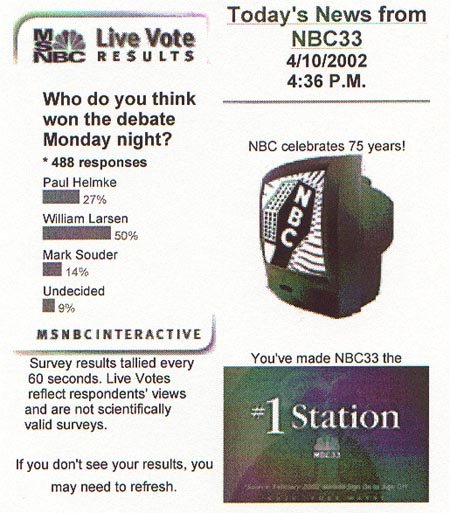
I’m William Larsen, a Candidate for Indiana's 3rd District U.S. Representative. I’m a navy veteran, engineer, husband and father of five children. I want to restore the American Dream, where in a land of opportunity an individual can work hard and prosper.
I grew up in Fort Wayne and graduated from Paul Harding High School in 1975. I am in scouting and earned my eagle rank in 1972. I enlisted in the U.S. Navy in 1977 and attained the rank of machinist mate 2nd class. I was honorably discharged from the U.S. Navy and attended Purdue University where I earned a Bachelor of Science in Mechanical Engineering. While in college I met my wife, Lenore. We have five children. I have worked for companies dealing with components for the U.S. Nuclear Navy and high level waste to filtration products. I solve problems for a living. The key to good problem solving is to identify the root cause. Unless the root cause is identified, no problem will ever be solved. Does the City of Fort Wayne have problems?